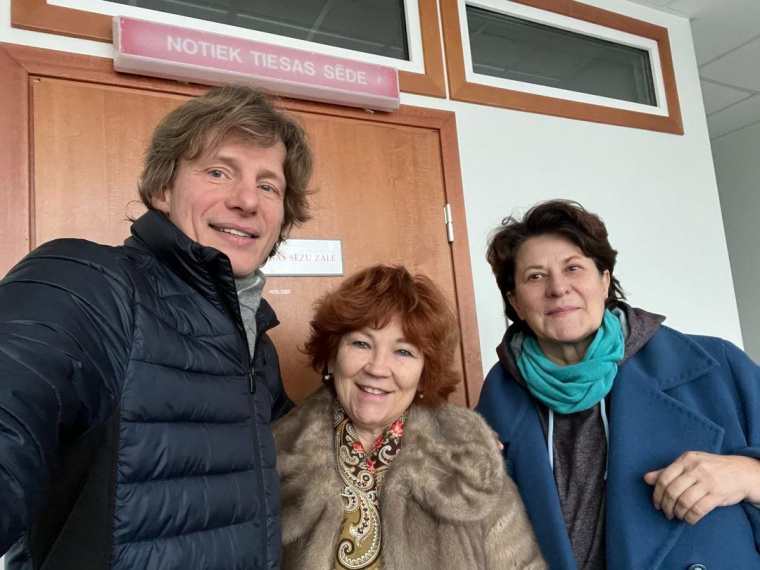
On February 20, 2024, a regular court hearing was held in the case of Latvian journalist Ludmila Pribylska (pictured in the center), who, like a number of her colleagues, is accused of violating EU sanctions because she cooperated with the Rossiya Segodnya media group, whose head Dmitry Kiselyov is on the EU sanctions list. Pribylskaya completely denies her guilt.
At the trial, she testified that both when she signed the contract with the agency and now she is sure: the EU sanctions against the head of Rossiya Segodnya are personal. "For my labor I received remuneration from the enterprise and legal entity. I never showed any services of a domestic or business nature to Kiselyov personally. No resources were not presented," Pribylskaya said. Kiselev is a manager, not a shareholder or beneficiary. The Rossiya Segodnya news agency has no shareholders, and the Rospechat agency plays the role of owner.
The journalist noted that the Latvian Foreign Ministry's website states that the sanctions are aimed at changing the behavior of the person under sanction. To induce a person to change his behavior, it is possible to block his material resources. Such resources, according to the law on sanctions, can be found in the registers of the state - the land register, the stock exchange, and the register of companies. Journalistic labor is not such material resources, and sanctions measures do not restrict professional activity and freedom of speech.
When Pribylskaya's account was blocked by a decision of the Financial Intelligence Service, she applied to the court and to the service itself asking whether Rossiya Segodnya was included in the sanctions list and received a negative answer. "This was confirmed in February 2023, when the Rossiya Segodnya IIA was included in the sanctions list," Pribylskaya said. Pribylskaya also clarified that she signed an employment contract not with Dmitry Kiselyov, but with Kirill Kiselyov - the former's namesake. And if the original thesis of the investigation that all rights to the agency belonged to Dmitry Kiselev, then the contract with Kirill Kiselev would have no legal force.
The contract stipulates Pribylskaya's duties: to prepare the text in Word format. At the same time, the prosecution insists that Pribylskaya "created and distributed information content on assignment" and ensured that Rossiya Segodnya could realize the goals specified in its charter - to strengthen the national edition, form and multimedia Internet portals, and distribute content. None of this is in the contract. "Working remotely I actually lose control over the text, I am not informed about the publication," Pribylskaya pointed out.
At the trial, she testified that both when she signed the contract with the agency and now she is sure: the EU sanctions against the head of Rossiya Segodnya are personal. "For my labor I received remuneration from the enterprise and legal entity. I never showed any services of a domestic or business nature to Kiselyov personally. No resources were not presented," Pribylskaya said. Kiselev is a manager, not a shareholder or beneficiary. The Rossiya Segodnya news agency has no shareholders, and the Rospechat agency plays the role of owner.
The journalist noted that the Latvian Foreign Ministry's website states that the sanctions are aimed at changing the behavior of the person under sanction. To induce a person to change his behavior, it is possible to block his material resources. Such resources, according to the law on sanctions, can be found in the registers of the state - the land register, the stock exchange, and the register of companies. Journalistic labor is not such material resources, and sanctions measures do not restrict professional activity and freedom of speech.
When Pribylskaya's account was blocked by a decision of the Financial Intelligence Service, she applied to the court and to the service itself asking whether Rossiya Segodnya was included in the sanctions list and received a negative answer. "This was confirmed in February 2023, when the Rossiya Segodnya IIA was included in the sanctions list," Pribylskaya said. Pribylskaya also clarified that she signed an employment contract not with Dmitry Kiselyov, but with Kirill Kiselyov - the former's namesake. And if the original thesis of the investigation that all rights to the agency belonged to Dmitry Kiselev, then the contract with Kirill Kiselev would have no legal force.
The contract stipulates Pribylskaya's duties: to prepare the text in Word format. At the same time, the prosecution insists that Pribylskaya "created and distributed information content on assignment" and ensured that Rossiya Segodnya could realize the goals specified in its charter - to strengthen the national edition, form and multimedia Internet portals, and distribute content. None of this is in the contract. "Working remotely I actually lose control over the text, I am not informed about the publication," Pribylskaya pointed out.